 Alkarbala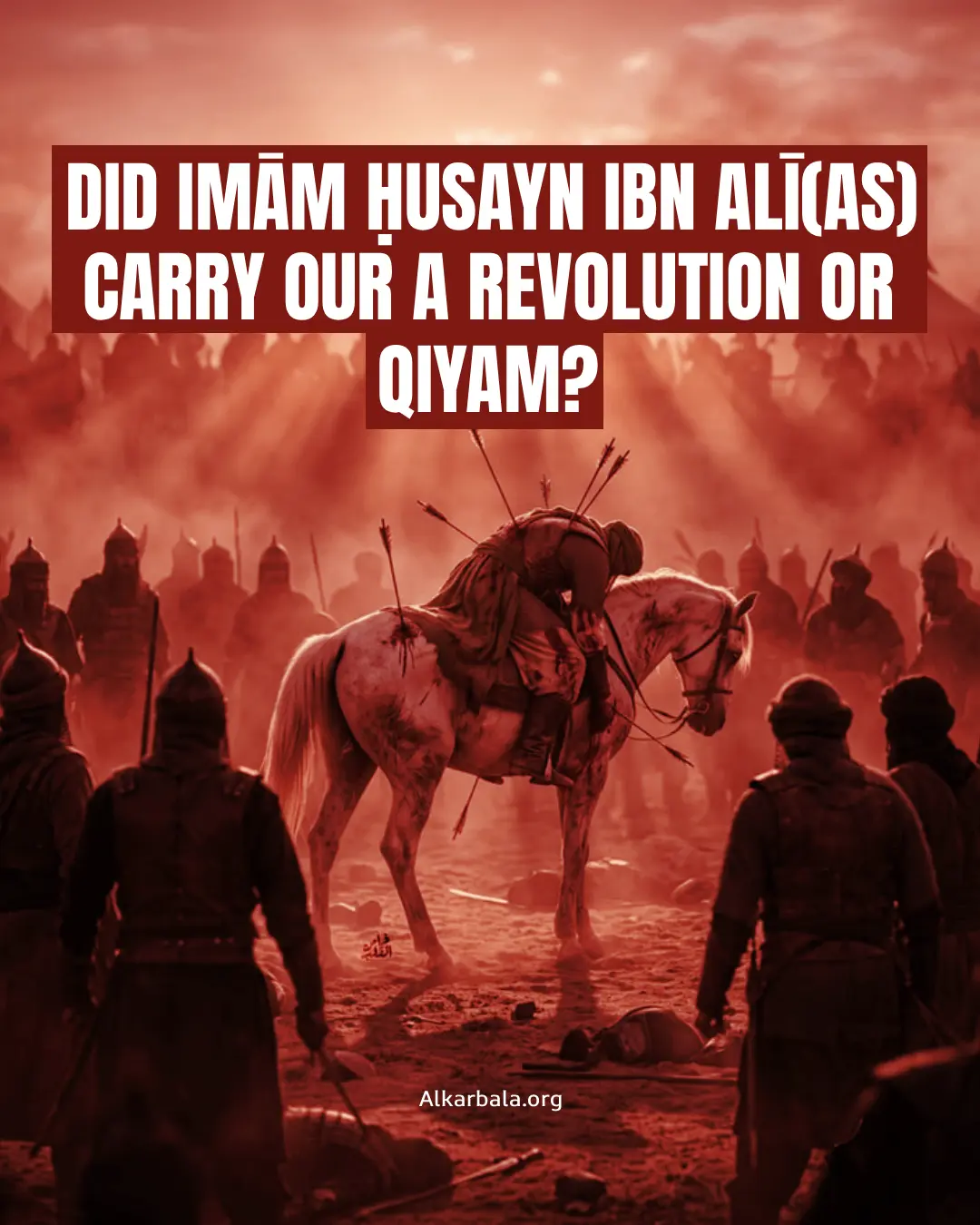
Did Imām Ḥusayn ibn ʿAlī (ʿalayhi al-salām) Carry Out a Revolution or Qiyām?
We begin by examining whether Imām Ḥusayn ibn ʿAlī (ʿalayhi al-salām) carried out a revolution or qiyām, on what basis such an act would have occurred, and—most importantly—whether Imām Ḥusayn (ʿalayhi al-salām) ever intended to establish a revolution in the first place.
A revolution is defined as the overthrow or radical transformation of an existing government or ruling system. Linguistically, inqilāb means to turn something upside down or to change it from one state into another.
The most critical point that must be presented—one which fundamentally dismantles the widely circulated narrative that Imām Ḥusayn (ʿalayhi al-salām) rose in order to establish an uprising, qiyām, or political revolution—is the following:
If Imām Ḥusayn (ʿalayhi al-salām) rose against Yazīd on the grounds that Yazīd was a tyrant, oppressor, and corrupter of religion, then a decisive question arises: why did Amīr al-Muʾminīn ʿAlī ibn Abī Ṭālib (ʿalayhi al-salām) not rise in the same manner before him? Likewise, Imām al-Ḥasan (ʿalayhi al-salām) possessed companions and supporters—why did he not undertake a qiyām? Were the rulers of their respective eras not unjust and oppressive? Were religious innovations (bidʿah) not already being introduced into Islam?
If someone asserts that Imām Ḥusayn (ʿalayhi al-salām) led an uprising or revolution, then evidence is required, for every claim necessitates proof. Hence, the essential question remains:
Was this truly what Imām Ḥusayn ibn ʿAlī (ʿalayhi al-salām) intended to do?
The answer is an unequivocal no.
This is because our narrations explicitly state—through the words of the Messenger of Allah (ṣallallāhu ʿalayhi wa-ālihi)—that the rule of Banū Umayyah was divinely decreed to last one thousand months. Consequently, it becomes evident that any attempt by Imām Ḥusayn (ʿalayhi al-salām) to establish a political qiyām or inqilāb during that period would necessarily fail.
This is clearly recorded in al-Kāfī, Vol 4, Page 96. Hadith 10:
-أَحْمَدُ بْنُ مُحَمَّدٍ، عَنْ عَلِيِّ بْنِ الْحُسَيْنِ، عَنْ مُحَمَّدِ بْنِ الْوَلِيدِ ؛ مَّدِ بْنِ الْوَلِيدِ؛ وَمُحَمَّدِ بْنِ أَحْمَدَ، عَنْ يُونُسَ بْنِ
يَعْقُوبَ، عَنْ عَلِيِّ بْنِ عِيسَى الْقَمَاطِ، عَنْ عَمْهِ، عَنْ أَبِي عَبْدِ اللَّهِ قَالَ : رَأَى رَسُولُ اللَّهِ ﷺ فِي مَنَامِهِ بَنِي أُمَيَّةَ يَصْعَدُونَ عَلَى مِنْبَرِهِ مِنْ بَعْدِهِ وَيُضِلُّونَ النَّاسَ عَنِ الصِّرَاطِ الْقَهْقَرَى فَأَصْبَحَ كَثِيباً حَزِيناً قَالَ : فَهَبَطَ عَلَيْهِ جَبْرَئِيلُ فَقَالَ : يَا رَسُولَ اللَّهِ مَا لِي أَرَاكَ كَثِيباً حَزِيناً قَالَ : يَا جَبْرَئِيلُ إِنِّي رَأَيْتُ بَنِي أُمَيَّةَ فِي لَيْلَتِي هَذِهِ يَصْعَدُونَ مِنْبَرِي مِنْ بَعْدِي وَيُضِلُّونَ النَّاسَ عَنِ الصِّرَاطِ الْقَهْقَرَى فَقَالَ : وَالَّذِي بَعَثَكَ بِالْحَقِّ نَبِيّاً إِنَّ هَذَا شَيْءٌ مَا اطَّلَعْتُ عَلَيْهِ فَعَرَجَ إِلَى السَّمَاءِ فَلَمْ يَلْبَتْ أَنْ نَزَلَ عَلَيْهِ بِأَي مِنَ الْقُرْآنِ يُؤْنِسُهُ بِهَا قَالَ : أَفَرَيْتَ إِن مَّتَعْتَهُمْ سِنِينَ ثُمَّ جَاءَهُم مَّا كَانُوا يُوعَدُونَ مَا أَغْنَى عَنْهُم مَّا كَانُوا يُمَتَّعُونَ ) [الشعراء: ٢٠٥-۲۰۷] وأَنْزَلَ عَلَيْهِ ﴿إِنَّا أَنزَلْتَهُ فِي لَيْلَةِ الْقَدْرِ وَمَا أَدْرَنكَ مَا لَيْلَةُ الْقَدْرِ لَيْلَةُ الْقَدْرِ خَيْرٌ مِّنْ أَلْفِ شَهْرٍ ﴾ [القدر: ١-٣) جَعَلَ اللَّهُ عَزَّ وَجَلَّ لَيْلَةَ الْقَدْرِ لِنَبِيهِ خَيْراً مِنْ أَلْفِ شَهْرٍ مُلْكِ بَنِي أُمَيَّةَ .
Ahmad ibn Muhammad, from ʿAli ibn al-Husayn, from Muhammad ibn al-Walid, and Muhammad ibn Ahmad, from Yunus ibn Yaʿqub, from ʿAli ibn ʿIsa al-Qammāt, from his uncle, from Abu ʿAbdillah (peace be upon him), who said: The Messenger of Allah ﷺ saw in his dream that the Banū Umayyah were ascending his pulpit after him and leading the people astray from the straight path, driving them backwards. So he awoke deeply distressed and sorrowful.
He said: Then Jibrīl descended to him and said, “O Messenger of Allah, why do I see you so distressed and sorrowful?” He replied, “O Jibrīl, I saw in my dream tonight that the Banū Umayyah were ascending my pulpit after me and leading the people astray from the straight path, driving them backwards.” Jibrīl said, “By the One who sent you with the truth as a Prophet, this is something I was not aware of.” Then he ascended to the heavens.
It was not long before he descended again with verses from the Qur’an to console him, saying:
‘Have you considered: if We let them enjoy themselves for years, then what they were promised comes to them, of what benefit to them would be that which they used to enjoy?’
(Qur’an, al-Shuʿarāʾ 26:205–207)
And He revealed to him: ‘Indeed, We sent it down on the Night of Decree. And what will make you know what the Night of Decree is? The Night of Decree is better than a thousand months.’
(Qur’an, al-Qadr 97:1–3)
Allah, Mighty and Exalted, made the Night of Decree for His Prophet better than a thousand months of the rule of the Banū Umayyah.
The narration states that the Messenger of Allah (ṣallallāhu ʿalayhi wa-ālihi) saw Banū Umayyah ascending his pulpit and misleading the people after him. He awoke distressed and sorrowful, whereupon Jibrīl descended and informed him that Allah had revealed verses to console him. Among them was the declaration that Laylat al-Qadr is better than a thousand months, meaning better than a thousand months of Umayyad rule.
Allah, Mighty and Majestic, made the Night of Decree for His Prophet better than a thousand months of the rule of the Banū Umayyah.

This narration makes it abundantly clear that Imām Ḥusayn ibn ʿAlī (ʿalayhi al-salām) did not undertake a qiyām or inqilāb. Rather, the only one destined to establish the true Qiyām is Imām al-Qāʾim (ʿajjalallāhu farajahu). God willing, this subject will be discussed in detail in future writings.
Another narration reinforcing this understanding is found in Kamāl al-Dīn wa Tamām al-Niʿmah, Page 281 Chapter: 55:
Abi Ja'far Muhammad bin Ali al-Baqir (a.s.):
"May God bless you, we have stopped going to the markets in anticipation of the reappearance. The Imam said: O Abdul Hamid do you think that Allah will not open the way for one who controls his self for His sake? No, by Allah, Allah will indeed open a way for him. May Allah have mercy on one who controls his self for our sake. May Allah have mercy on one who keeps our matter alive. I asked: What if I die before the time of Imam Qaim? He replied: If one of you makes an intention that he is present in the time of Qaim of Aale Muhammad, he will render help to him, he is like the one who fights in his company; rather he is like one who is martyred in his company.

Why Did Imām Ḥusayn (ʿalayhi al-salām) Leave Madīnah?
A question frequently raised is: if Imām Ḥusayn (ʿalayhi al-salām) was not revolutionary in nature, then why did he leave Madīnah?
The answer is straightforward. Upon the death of Muʿāwiyah, Imām al-Ḥusayn (ʿalayhi al-salām) was subjected to intense pressure by the Umayyad authorities to publicly pledge allegiance (bayʿah) to Yazīd. This pressure escalated to the point that a mission was assigned to assassinate him should he refuse. Consequently, Imām al-Ḥusayn (ʿalayhi al-salām) was compelled to leave Madīnah and seek refuge in Makkah.
This incident is recorded in the narration of Juwayriyyah, wherein Marwān attempted to kill both Ibn al-Zubayr and Imām al-Ḥusayn (ʿalayhi al-salām). Both resorted to taqiyyah, claiming they would pledge allegiance the following day, and then departed Madīnah. This account is reported by Abū Mikhnaf in Tārīkh al-Ṭabarī, Vol. 19, pp. 2–6:

Why Did He Leave Makkah?
The next question naturally arises: after reaching Makkah, why did Imām Ḥusayn (ʿalayhi al-salām) also leave this sacred city?
The reason is explained in his discussion with Ibn ʿAbbās, recorded in Muṣannaf Ibn Abī Shaybah, Vol. 21, p. 283, Hadith no. 40147, P283:
Ḥusayn ibn ʿAlī narrated to us, from Ibn ʿUyaynah, from Ibn Ṭāwūs, from his father, who said:
Ibn ʿAbbās said:
“Ḥusayn came to me seeking my counsel about going out to this place—meaning Iraq.
I said to him: Were it not that people would disparage both me and you, I would have seized you by the hair with my hands!
Where are you going—to a people who killed your father and stabbed your brother?
What then comforted my soul regarding him was that he said to me:
Indeed, this Sanctuary (the Ḥaram) will be violated because of a man; and for me to be killed in such-and-such a land—far away from it—is more beloved to me than that I should be that man.”

In this narration, Imām al-Ḥusayn (ʿalayhi al-salām) makes it explicitly clear that he did not wish to be the cause by which the sanctity of the Ḥaram would be violated. He preferred to be killed elsewhere rather than allow bloodshed within Makkah. This prophecy was later fulfilled during the siege of Makkah under Ibn al-Zubayr, when the Kaʿbah was attacked and burned.
After leaving Makkah, Imām al-Ḥusayn (ʿalayhi al-salām) proceeded toward Kūfa, having received numerous letters from its people expressing opposition to Umayyad rule. Despite the counsel of many companions advising him not to go, he continued his journey.
The question of whether Imām al-Ḥusayn (ʿalayhi al-salām) erred in choosing Kūfa depends entirely on what objective one assumes he sought to fulfill. If it is claimed that he went believing the Kūfans would establish his rule, then this claim is entirely unfounded. The evidence clearly shows that Imām al-Ḥusayn (ʿalayhi al-salām) was aware that he would be deserted. However, his objective was far greater—an objective unknown even to many of his advisers.
His Foreknowledge of Martyrdom
This discussion conclusively proves that Imām Ḥusayn (ʿalayhi al-salām) did not seek an uprising or qiyām. Furthermore, it is firmly established that he knew—through the prophecy of his grandfather, the Messenger of Allah (ṣallallāhu ʿalayhi wa-ālihi)—that he would be martyred by the Ummah itself. The Umayyads would kill him regardless of whether he fled, hid, or remained in place.
This is confirmed by Imām al-Ḥusayn (ʿalayhi al-salām) himself in numerous sources. For example, in al-Kharāʾij wa-l-Jarāʾiḥ by Quṭb al-Rāwandī, Vol. 1, pp. 253–254, we read the narration of Umm Salamah.

This narration clearly establishes that Imām Ḥusayn (ʿalayhi al-salām) was fully aware of his martyrdom. Thus, how can one claim that his movement constituted a political revolution or inqilāb?
Was This Suicide?
Some among the Sunnis raise the objection that since Imām al-Ḥusayn (ʿalayhi al-salām) knew of his impending death, his actions amounted to suicide. This accusation is entirely false.
It is undeniable that Imām al-Ḥusayn (ʿalayhi al-salām) possessed ʿilm al-ghayb granted to him by the Messenger of Allah (ṣallallāhu ʿalayhi wa-ālihi), and Sunni sources themselves attest to this fact. Historical reports transmitted through Sunni chains clearly confirm that Imām al-Ḥusayn (ʿalayhi al-salām) knew he was heading toward certain death.
For instance, this is recorded in al-Muʿjam al-Kabīr, Vol. 16, Hadith no. 637, Page 253-254:

When al-Ḥusayn intended to go to Iraq, Umm Salama said to him:
“By Allah, by Allah! Do not go out to Iraq.
For I heard the Messenger of Allah say:
‘My son al-Ḥusayn will be killed in the land of Iraq,’
and he had with him a vial, and he gave me soil from that land.”
Al-Ḥusayn replied:
“By Allah, I shall indeed be killed in that manner. And if I do not go to Iraq, they will kill me as well.
And I love to know my resting place, and the place of my martyrdom, and the places where my companions will fall.”
Then he struck his hand upon her chest until she could see, and said:
“This is its soil.”
He took a handful of that soil and placed it in another container as well, and said:
“When this turns into blood, then know that I have been killed.”
Umm Salama said:
“When the Day of ʿĀshūrāʾ arrived, I looked at the two containers after noon, and I cried out—
for I found that what was beneath them had turned into flowing blood.”

Why This Was Not Suicide
Suicide is the deliberate act of ending one’s life out of despair or rejection of existence. Sacrifice, on the other hand, is the willing acceptance of death when no honorable alternative remains. Even when death is known in advance, choosing dignity over humiliation does not constitute suicide.
Imām al-Ḥusayn (ʿalayhi al-salām) did not despise life, nor did he seek death. Had honorable life been available, he would have chosen it. However, when faced with the choice between submission to Yazīd or martyrdom, he chose honor.
A clear parallel exists in the martyrdom of Jaʿfar al-Ṭayyār (ʿalayhi al-salām) at the Battle of Muʾtah, as recorded in Ṣaḥīḥ al-Bukhārī.
The Origins of the “Revolutionary” Narrative
Finally, we must ask: who introduced the idea that Imām Ḥusayn (ʿalayhi al-salām) was a political revolutionary?
As you all know, when the Islamic Revolution came to Iran, the center Hawza Qom was the intellectual center there.The teachings given there were of such a kind that the system could be supported by the revolution.As you all know, there is very little/Nadir teachings of our Imams about standing up and fighting the government.The Imams have always commanded the Shiites to practice taqiyya, so in this situation it was very difficult for them to convey their teachings as if the Imams had taught revolution and qayam..
Saleh Najafabadi was a 20th-century Iranian cleric and Islamic scholar known for his independent thinking, reformist ideas, and controversial reinterpretation of early Shia history. He was born in 1923/24 in Najafabad, Isfahan province (Iran) and died in 2006 in Tehran.he was placed under house arrest, barred from teaching and receiving students, and his writings were censored.
This is the person who first introduced this ideology among the Shia’s his book Shahid-e-Javid (Persian: The Eternal Martyr) is Salehi Najafabadi’s most controversial work, first conceived in the early 1960s and published in the late 1960s/1970 (various editions exist). In his book he said Husayn acted to mobilize support for just governance and resisted Yazid’s demand for allegiance based on principled political opposition, emphasizing human agency and strategy over mystical inevitability..
Conclusion
I respectfully request all of you that whenever you hear something from a preacher/Scholar, you should research it as much as you can.How the purpose of Imam Hussain (a.s.) was transformed into something that was in direct contradiction to the hadith of the Prophet (s.a.w.s.)Imām Ḥusayn ibn ʿAlī (ع) established the uprising,he does the Qayam/inqilab, while there is nothing like that in our hadith. inshallah, we will continue to present these writings/Risalah to all of you, Believers so that you can all benefit from them. Inshallah Fatima صلوات الله عليها will accept what I have written.🤲🏻 inshallah we'll continue to add more refrence over this topic inshallah..
And indeed, Allah knows the best!