Al-Musannaf by Abd Al Razzaq, vol. 6, pg. 249, #11194:
١١١٩٤ - عبد الرزاق، عن ابن عيينة، عن عمرو بن دينار، عن أبي جعفر قال: خطب عمر إلى علي ابنته، فقيل: إنها صغيرة، فقيل لعمر: إنما يريد بذلك منعها، قال: فكلمه، فقال علي: أبعث بها إليك، فإن رضيت فهي امرأتك.
قال: فبعث بها إليه، قال: فذهب عمر فكشف عن ساقها، فقالت: أرسل، فلولا أنك أمير المؤمنين لصككت عينك.
11194 - Abd al-Razzaq narrated from Ibn Uyaynah, from Amr ibn Dinar, from Abu Ja’far, who said:
Umar proposed to Ali for his daughter’s hand.
It was said: “She is too young.”
Someone told Umar: “Ali is only trying to prevent this marriage.”
So Umar spoke to him, and Ali said: “I will send her to you. If you are pleased with her, she is your wife.”
Ali then sent her to him.
Umar went to her and uncovered her leg.
She said: “Let go! If you were not the Commander of the Faithful, I would have struck your eye.”
Uploaded on: 2026-01-10 15:56:45
Credit: mujtaba ali

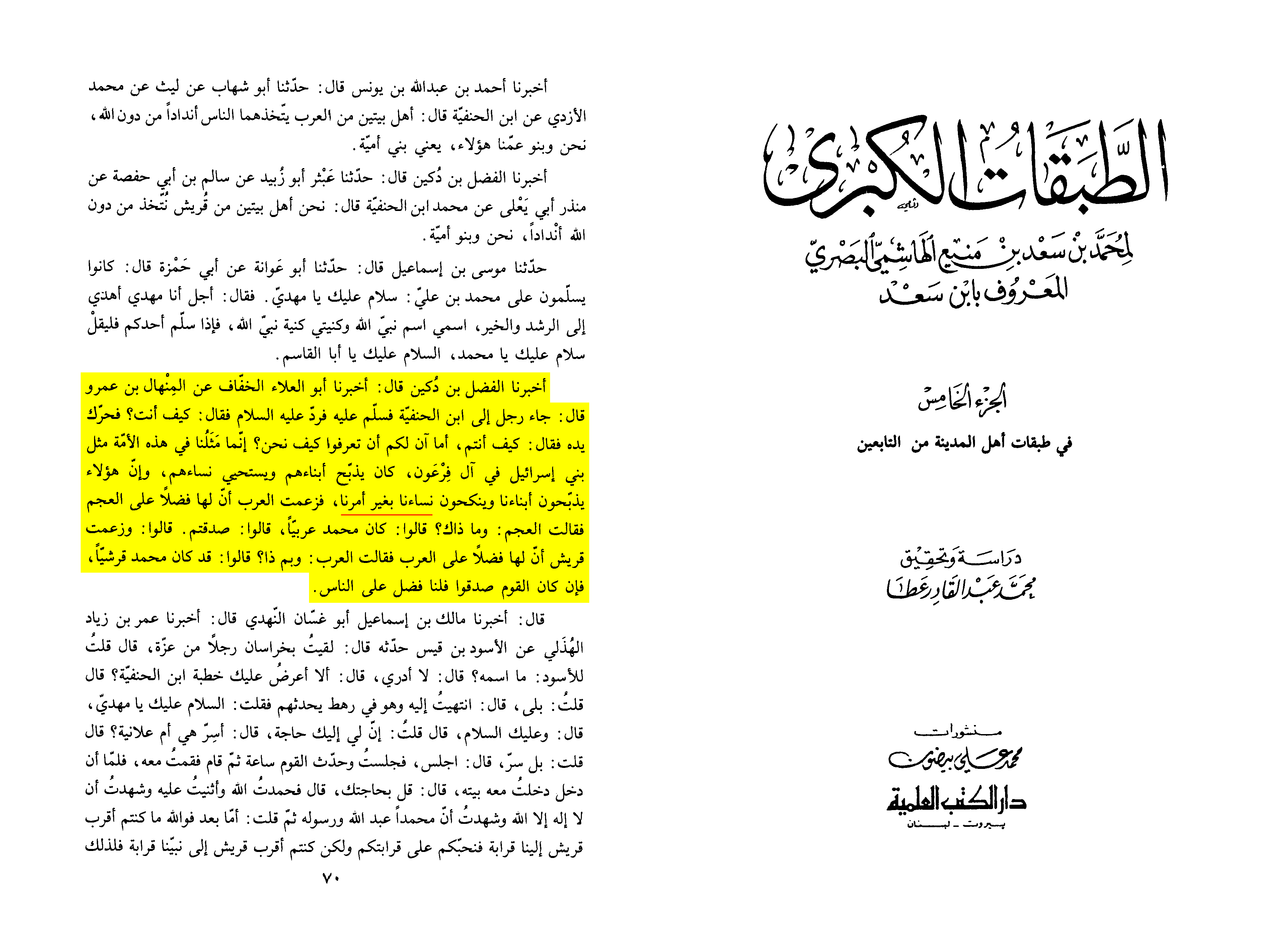
Tabaqat al-Kubra, vol. 5, pg. 70, by Ibn Sa’d:
أخبرنا الفضل بن دكين قال: أخبرنا أبو العلاء الخفاف عن المنهال بن عمرو قال: جاء رجل إلى ابن الحنفية فسلّم عليه، فردّ عليه السلام، فقال: كيف أنت؟ فحرك يده، فقال: كيف أنتم؟ أما آن لكم أن تعرفوا كيف نحن؟ إنما مثلنا في هذه الأمة مثل بني إسرائيل في آل فرعون، كان يذبح أبناءهم ويستحيي نساءهم، وإن هؤلاء يذبحون أبناءنا وينكحون نساءنا بغير أمرنا. فزعمت العرب أن لها فضلاً على العجم، فقالت العجم: وما ذاك؟ قالوا: كان محمد عربياً، قالوا: صدقتم. قالوا: وزعمت قريش أن لها فضلاً على العرب، فقالت العرب: وبم ذا؟ قالوا: قد كان محمد قرشياً، فإن كان القوم صدقوا فلنا فضل على الناس.
Al-Fadl b. Dukayn narrated to us, saying: Abu al-ʿAlaʾ al-Khifaf narrated to us from al-Minhāl b. ʿAmr, who said: A man came to Ibn al-Hanafiyyah and greeted him with salām. He returned the greeting, and the man asked, “How are you?” Ibn al-Hanafiyyah moved his hand and said, “How are you? Has the time not come for you to understand our situation? Our likeness in this nation is like that of the Children of Israel under Pharaoh’s rule—he would slaughter their sons and keep their women alive. Likewise, these people slaughter our sons and marry our women without our permission.”
Then he continued, “The Arabs claimed they had superiority over the non-Arabs.” The non-Arabs asked, “Why is that?” The Arabs responded, “Because Muhammad was an Arab.” The non-Arabs replied, “You have spoken the truth.”
Then he said, “Quraysh claimed superiority over the Arabs.” The Arabs asked, “On what basis?” Quraysh responded, “Because Muhammad was from Quraysh.” Then, if what they say is true, we too have superiority over the people.”
Uploaded on: 2026-01-10 15:55:49
Credit: mujtaba ali

al-Tabaqat al-Kubra by Ibn Saad, Vol. 8, pg. 338 - 339
أخبرنا أنس بن عياض الليثي عن جعفر بن محمد عن أبيه أن عمر بن الخطاب خطب إلى علي بن أبي طالب ابنته أم كلثوم، فقال علي: إنما حبست بناتي على بني جعفر. فقال عمر: أنكحنيها يا علي فوالله ما على ظهر الأرض رجل يرصد من حسن صحابتها ما أرصد. فقال علي: قد فعلت. فجاء عمر إلى مجلس المهاجرين بين القبر والمنبر، وكانوا يجلسون ثمّ عليّ وعثمان والزبير وطلحة وعبد الرحمن بن عوف فإذا كان الشيء يأتي عمر من الآفاق جاءهم فأخبرهم ذلك واستشارهم فيه. فجاء عمر فقال: رفّئوني. فرفّؤوه وقالوا: بمن يا أمير المؤمنين؟ قال: بابنة علي بن أبي طالب. ثم أنشأ يخبرهم فقال: إن النبي صلى الله عليه وسلم، قال: «كل نسب وسبب منقطع يوم القيامة إلا نسبي وسببي»، وكنت قد صحبته فأحببت أن يكون هذا أيضاً.
Anas ibn Iyad al-Laythi reported from Ja'far ibn Muhammad, from his father, that Umar ibn al-Khattab proposed to Ali ibn Abi Talib for his daughter, Umm Kulthum. Ali said, “I have reserved my daughters for the sons of Ja'far.” Umar replied, “Marry her to me, Ali, for by Allah, there is no man on the face of the earth who will look after her as I will.” Ali said, “I have done so.” Umar then went to the gathering of the Muhajirun between the grave and the pulpit, where they used to sit, including Ali, Uthman, Zubair, Talha, and Abd al-Rahman ibn Awf.
Whenever Umar received news from various regions, he would come to them, inform them, and consult them about it. Umar came and said, “Congratulate me.” They congratulated him and asked, “With whom, O Commander of the Faithful?” He replied, “With the daughter of Ali ibn Abi Talib.” Then he began to explain to them, saying, “The Prophet (peace be upon him) said, ‘Every lineage and connection will be severed on the Day of Judgment except my lineage and my connection.’ I had been close to him, so I wanted this as well.”
Uploaded on: 2026-01-10 15:55:06
Credit: mujtaba ali

We read in Al-Fatāwā al-Ḥadīthiyyah by Ibn Hajar al-Haytami, page 69:
"Scholars differed regarding the permissibility of marrying them (the jinn) according to Sharia. It is reported from Mālik (may Allah be pleased with him) that he allowed it, but he disliked it so that a woman claiming to be pregnant from adultery would not be attributed to a jinn."
Uploaded on: 2025-09-27 19:27:28
Credit: alkarbala_scans

We also read in Ālam al-Jinn fī Ḍaw’ al-Kitāb wa al-Sunnah, Page 172:
"Belief in the world of the jinn is like belief in any other matter of the unseen, such as the existence of Allah, the angels, Paradise and Hell, and the Day of Judgment. Whoever denies any one of these matters is considered to have denied them all, because in doing so, they have rejected what the Qur’an and the Sunnah have affirmed. Faith is complete and indivisible; for example, belief in the angels while denying the jinn undermines faith from its very foundation. Whoever necessarily denies a known matter of religion has therefore fallen into disbelief(Kufr)."
Uploaded on: 2025-09-27 19:19:12
Credit: alkarbala_scans

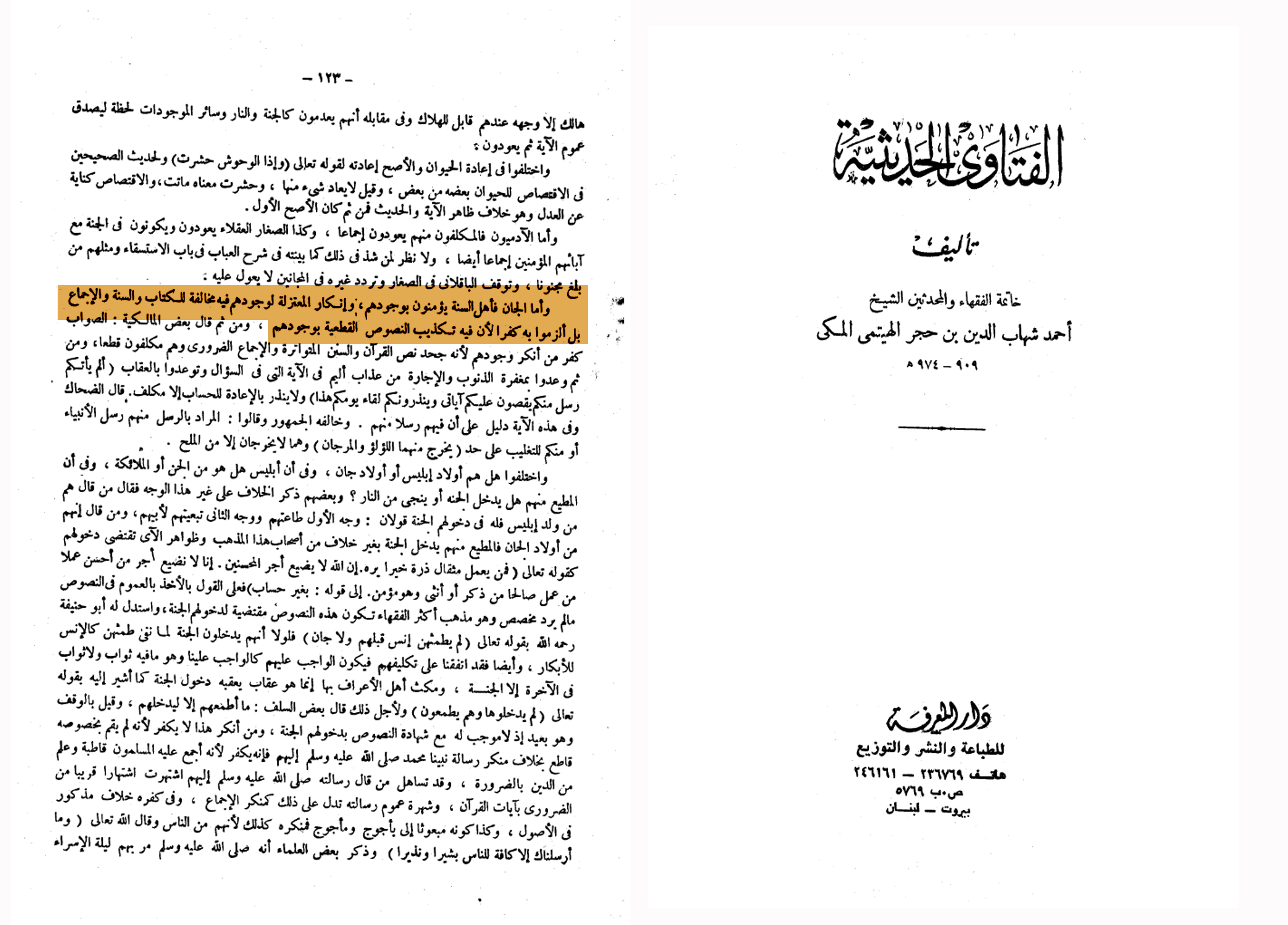
We read in Al-Fatāwā al-Ḥadīthiyyah by Ibn Hajar al-Haytami, page 123:
"As for the jinn, the Ahl al-Sunnah believe in their existence. The denial of their existence by the Mu‘tazila is in opposition to the Qur’an, the Sunnah, and consensus. In fact, some of them went so far as to declare it disbelief(Kufr), because it entails denying the clear textual evidence of their existence."
Uploaded on: 2025-09-27 19:09:40
Credit: alkarbala_scans

We read in Al-Kharāʾij wa al-Jarāʾiḥ by Quṭb al-Dīn al-Rāwandī, vol 2, Page 825
From Abū Basīr (3), Jad‘ān ibn Naṣr narrated: Abū ‘Abdillāh Muhammad ibn Mas‘adah (4) told us: Muhammad ibn Ḥumwayh ibn Ismā‘īl al-Arbanū’ī narrated from Abū ‘Abdillāh al-Zubaynī (5), from ‘Umar ibn Adhīnah, who said:
It was said to Abū ‘Abdillāh (peace be upon him): “People argue against us and say: ‘Amīr al-Mu’minīn (peace be upon him) married so-and-so’s daughter, Umm Kulthūm.’”
He was silent for a moment, then sat and said:
“Do you accept that ‘Alī (peace be upon him) married someone’s daughter!?”
He continued:
“Those who claim this are misguided and do not follow the right path.”
He clapped his hands and said:
“Glory be to Allah! Was it not possible for Amīr al-Mu’minīn (peace be upon him) to prevent such a thing from happening and save her? They have lied; what they said never occurred.
Indeed, so-and-so proposed to ‘Alī only for the daughter Umm Kulthūm, but ‘Alī refused, and he said to al-‘Abbās:
‘By Allah, if we do not marry a jinn, you will not receive water from us or from Zamzam.’”
Al-‘Abbās approached ‘Alī (peace be upon him) to speak to him, but he refused. Al-‘Abbās insisted.
When Amīr al-Mu’minīn (peace be upon him) saw that it would be troublesome to speak with the man through al-‘Abbās, and that he would act according to what he said about the water, he sent a female jinn from Najrān, a Jewish woman named Suḥayqah bint Jarīriyyah. He commanded her, and she appeared in the likeness of Umm Kulthūm, covering the real Umm Kulthūm from view, and was sent to the man.
She remained with him until one day he grew suspicious and said:
“There is no family on earth more enchanting than Banu Hāshim.”
Then he wanted to show this to the people, so he killed her (the jinn impersonator) and kept the inheritance, then returned to Najrān. Amīr al-Mu’minīn (peace be upon him) then revealed the real Umm Kulthūm.
Uploaded on: 2025-09-27 18:56:09
Credit: alkarbala_scans

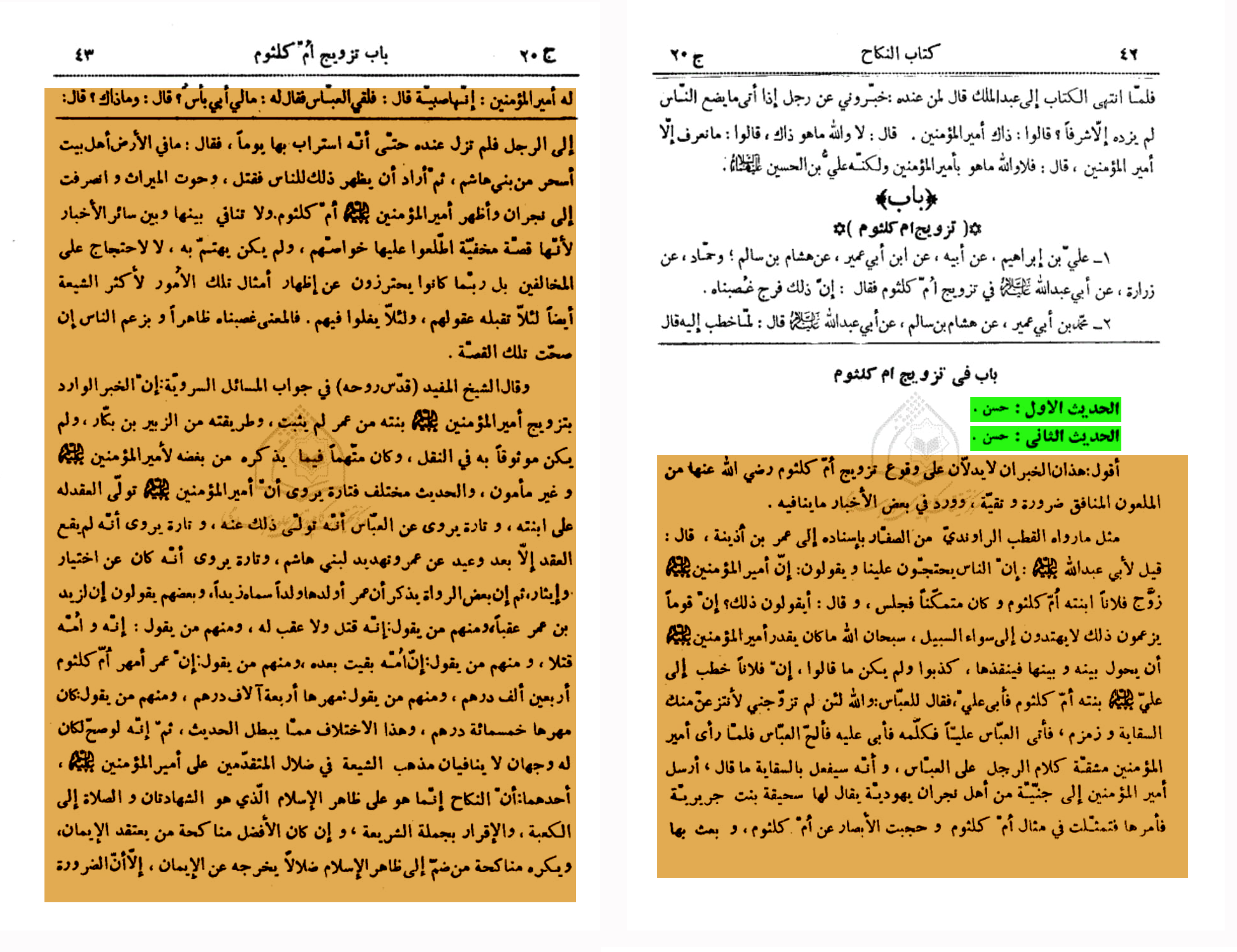
Allama majlisi in Mirat ul Uqool, Vol 20, p42 says:
Ḥasan.
I say: These two reports do not prove the occurrence of the marriage of Umm Kulthūm (may Allah be pleased with her) to that accursed hypocrite. Rather, they were due to compulsion and dissimulation (taqiyyah). And in some narrations we find what contradicts it.
Uploaded on: 2025-09-27 18:40:04
Credit: alkarbala_scans

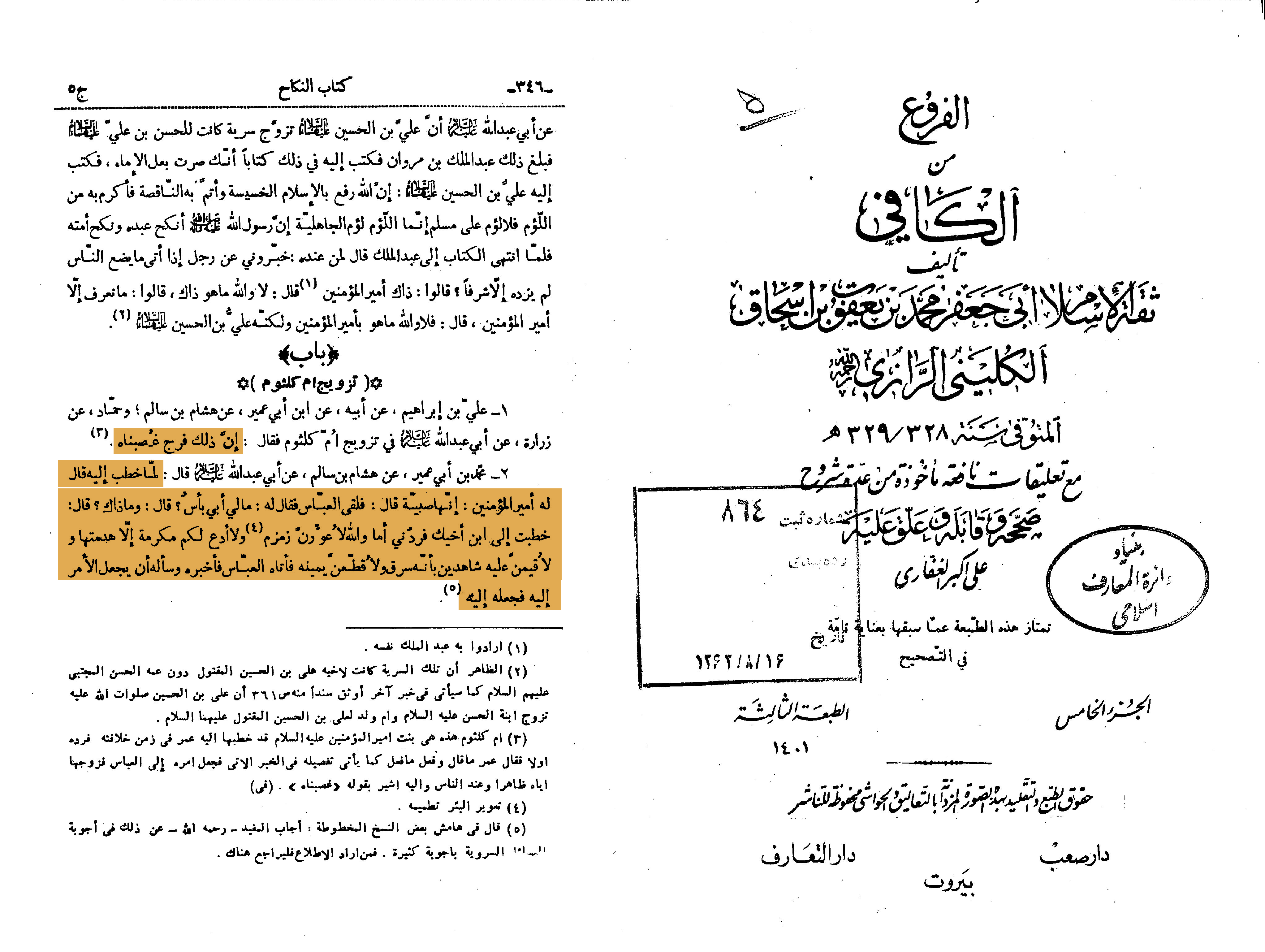
We Read in Al-kafi, vol 5, Page 346:
علي بن إبراهيم ، عن أبيه ، عن ابن أبي عمير ، عن هشام بن سالم ؛ وحماد ، عن زرارة ، عن أبي عبد الله الله في تزويج أم كلثوم فقال : إن ذلك فرج غصبناه .
ʿAlī ibn Ibrāhīm, from his father, from Ibn Abī ʿUmayr, from Hishām ibn Sālim; and Ḥammād, from Zurārah, from Abū ʿAbdillāh (Imam al-Ṣādiq, peace be upon him) regarding the marriage of Umm Kulthūm, he said: "That was a private part that was usurped from us."
Allama Majlisi in Mirat ul Uqool, Volume 20, Page 42 says that the hadith is “Hasan”
We Read in Al-kafi, vol 5, Page 346:
محمد بن أبي عمير ، عن هشام بن سالم ، عن أبي عبد الله الله قال : لما خطب إليه قال له أمير المؤمنين : إنها صبية قال : فلقى العباس فقال له : مالي أبي بأس ؟ قال : وماذاك ؟ قال : خطبت إلى ابن أخيك فردني أما والله لأعورن زمزم (٤) ولا أدع لكم مكرمة إلا هدمتها و لأقيمن عليه شاهدين بأنه سرق ولا قطعن يمينه فأتاه العباس فأخبره وسأله أن يجعل الأمر إليه فجعله إليه
Muḥammad ibn Abī ʿUmayr, from Hishām ibn Sālim, from Abū ʿAbdillāh (Imam al-Ṣādiq, peace be upon him), who said:
“When ʿUmar proposed to him (for marriage), Amīr al-Muʾminīn (ʿAlī, peace be upon him) said to him: ‘She is just a young girl.’
So ʿUmar went to al-ʿAbbās and said to him: ‘Do I have something wrong with me?’
He (al-ʿAbbās) replied: ‘And what is that?’
ʿUmar said: ‘I asked for your nephew’s (daughter) hand in marriage but he refused me. By Allah, I will close off Zamzam, I will not leave you with any honor except that I will destroy it, and I will bring two witnesses to testify that he (ʿAlī) stole, so I will have his right hand cut off.’
So al-ʿAbbās came to (ʿAlī) and informed him of this, and requested that the matter be left to him. So he (ʿAlī) handed the matter over to him (al-ʿAbbās).”
Allama Majlisi in Mirat ul’Uqool, Mirat ul uqool, Volume 20, Page 42 says:
The hadith is Hasan.
Uploaded on: 2025-09-27 18:25:02
Credit: alkarbala_scans

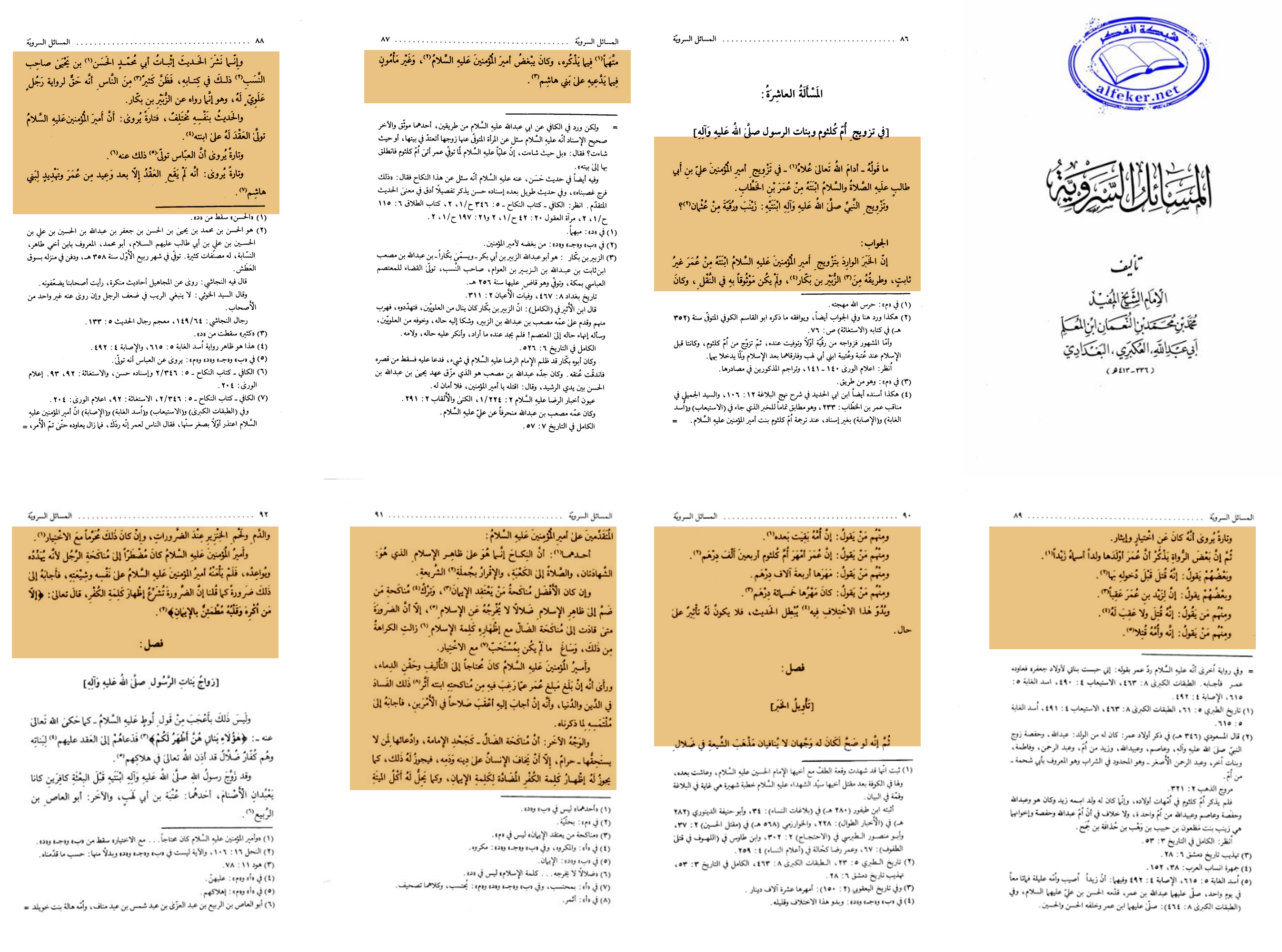
We read in Al-Masāʾil as-Sarawiyya – ash-Shaykh al-Mufīd – aṣ-Ṣafḥah 92:Issue Ten:
Regarding the marriage of Umm Kulthum and the daughters of the Prophet (peace be upon him and his family), what is the opinion — may Allah Almighty prolong his dignity — on the marriage of the Commander of the Faithful, Ali ibn Abi Talib (peace be upon him), of his daughter to Umar ibn Al-Khattab, and the Prophet’s (peace be upon him and his family) marriages of his daughters Zaynab and Ruqayyah to Uthman?**
Answer:
The report regarding the marriage of the Commander of the Faithful (peace be upon him) of his daughter to Umar is not authentic. Its chain of transmission comes from *al-Zubayr ibn Bakkar*, who was not considered trustworthy in narration. He was accused of fabricating reports, and he harbored hatred against the Commander of the Faithful (peace be upon him), and was not reliable in what he claimed regarding the Banu Hashim.
The report was primarily spread through Abu Muhammad al-Hasan ibn Yahya, a genealogist, in his book. Many people assumed the report to be true because it was narrated by an Alawite (a descendant of Ali), but he in fact quoted it from *al-Zubayr ibn Bakkar*.
The narration itself is inconsistent:
- At times it is said that the Commander of the Faithful (peace be upon him) himself conducted the marriage contract.
- At other times it is said that al-‘Abbas did it on his behalf.
- Another version claims the marriage only happened after Umar threatened and intimidated the Banu Hashim.
- And another version says it occurred willingly and by choice.
Some narrators say that Umar fathered a son from her named Zayd.
Others say that he was killed before consummation.
Some claim Zayd had descendants.
Others say he died without any descendants.
Some even claim that both he and his mother were killed.
Others say she lived after him.
There are also conflicting reports about her dowry:
- Some say Umar gave her a dowry of forty thousand dirhams.
- Others say it was four thousand dirhams.
- Still others say it was five hundred dirhams.
These contradictions invalidate the authenticity of the report and render it ineffective.
Interpreting the Report:
If, hypothetically, the report were authentic, there are two interpretations that do not contradict the Shia belief regarding the misguidance of those who preceded the Commander of the Faithful (peace be upon him):
**First Interpretation:**
Marriage is based on outward Islam, which is:
- Bearing witness to the two testimonies (Shahadatayn),
- Praying toward the Kaaba,
- And acknowledging the entirety of the Sharia.
While it is better to marry someone who holds true faith (Iman), and to avoid marrying those who, despite outwardly displaying Islam, harbor misguidance that does not expel them from Islam, necessity may at times permit marrying such individuals. Though not preferred, it becomes permissible in situations of necessity. The Commander of the Faithful (peace be upon him) may have found himself in a position where it was necessary to make peace and preserve lives. He saw that if he prevented Umar from marrying his daughter, it could lead to corruption in both religious and worldly matters. But if he agreed, it could lead to improvement in both. Therefore, he agreed for the sake of the greater good.
Second Interpretation:
Marriage with someone misguided — such as one who rejects the Imamate or claims it falsely — is prohibited. However, if one fears for their life or religion, then it becomes permissible, just as it is permissible to outwardly utter words of disbelief under compulsion. Likewise, eating dead meat, blood, or pork is allowed in cases of necessity, even though it is forbidden by default.
The Commander of the Faithful (peace be upon him) was compelled to marry his daughter to that man because he was being threatened and intimidated. He did not feel secure for himself or his followers. Therefore, he agreed out of necessity, just as necessity permits uttering words of disbelief. As Allah the Exalted says:
“Except for one who is forced while his heart is at rest with faith.”
Uploaded on: 2025-04-08 18:28:16
Credit: alkarbala_scans