A renowned sunni scholar Muḥammad Ṭāhir al-Fattānī in his book Tadhkirat al-Mawḍūʿāt, Page 96 states:
The ḥadīth of Asmāʾ regarding the return of the sun includes Faḍīl ibn Marzūq, who has been declared weak, and it has another chain that includes Ibn ʿUqdah, a Rāfiḍī who was accused of lying and labeled a lying Rāfiḍī. I say: Faḍīl is trustworthy (ṣadūq); Muslim and the four Sunan compilers relied upon him. As for Ibn ʿUqdah, he is among the great ḥadīth masters and trustworthy among the people. Those who weakened him were biased extremists. A number of scholars explicitly declared this ḥadīth authentic.
Among them is al-Qāḍī ʿIyāḍ. In al-Laʾālī, from Asmāʾ bint ʿUmays, it is narrated: “The Prophet (peace and blessings be upon him) was receiving revelation while his head was in ʿAlī’s lap, and he did not pray the afternoon prayer until the sun had set. He then said: ‘O Allah, indeed he was in obedience to You and obedience to Your Messenger, so return the sun for him.’ So it rose again after it had set.”
It was said that this ḥadīth is objectionable (munkar), and it was said that it is fabricated. I say: a group of leading ḥadīth masters explicitly stated that it is authentic. In al-Maqāṣid, the return of the sun for ʿAlī is mentioned. Aḥmad said, “It has no basis,” and Ibn al-Jawzī followed him; however, al-Ṭaḥāwī authenticated it, as did the author of al-Saqā, and likewise the return of the sun for the Prophet (peace and blessings be upon him).
Uploaded on: 2026-01-17 10:47:54
Credit: alkarbala_scans

A sunni Shaf'i Hadith Scholar Ismāʿīl ibn Muḥammad al-ʿAjlūnī al-Jarrāḥī in his book Kashf al-Khafā, Vol 1, Page 486 states:
Imām Aḥmad said: “It has no basis,” and Ibn al-Jawzī followed him and included it in al-Mawḍūʿāt (fabricated reports). However, al-Ṭaḥāwī declared it authentic, as did the author of al-Shifāʾ. It was also reported by Ibn Mandah and Ibn Shāhīn from Asmāʾ bint ʿUmays, and by Ibn Mardawayh from Abū Hurayrah.
al-Ṭabarānī narrated in al-Kabīr and al-Awsaṭ with a ḥasan (good) chain that the Prophet ﷺ commanded the sun and it was delayed for an hour of the day. Likewise, the sun was returned for the Prophet ﷺ when he informed (Quraysh) about the caravan he had seen on the Night Journey, saying they would arrive on such-and-such a day. Quraysh stood watching as the day was passing and they had not arrived, so the Prophet ﷺ supplicated, and an hour of the daytime was returned for him and the sun was held back.
Uploaded on: 2026-01-17 10:08:20
Credit: alkarbala_scans

A famous sunni shaf'i scholar al-Suyūṭī in his book Khaṣāʾiṣ al-Nabī, vol 2, Page 137 states:
Ibn Manda, Ibn Shāhīn, and al-Ṭabarānī narrated—through chains of transmission, some of which meet the criteria of authenticity (ṣaḥīḥ)—from Asmāʾ bint ʿUmays, who said:
“The Messenger of Allah (peace and blessings be upon him) was receiving revelation while his head was in ʿAlī’s lap, and he did not pray the afternoon prayer until the sun had set. The Messenger of Allah (peace and blessings be upon him) then said: ‘O Allah, indeed he was engaged in obedience to You and obedience to Your Messenger, so return the sun for him.’”
Asmāʾ said: “I saw it set, and then I saw it rise again after it had set.”
In another wording reported by al-Ṭabarānī: “The sun rose for him until it stood upon the mountains and upon the earth. ʿAlī then stood up, performed ablution, and prayed the afternoon prayer; then it set again. This occurred at al-Ṣahbāʾ.”
Al-Ṭabarānī also narrated with a sound (ḥasan) chain from Jābir that the Prophet (peace and blessings be upon him) commanded the sun, and it was delayed for an hour of the day.
Uploaded on: 2026-01-17 09:02:35
Credit: alkarbala_scans

A famous Sunni Mālikī scholar and ḥadīth commentator, Ibrāhīm ibn Muḥammad ibn Aḥmad al-Zurqānī in his book Sharḥ al-ʿAllāmah al-Zurqānī ʿalā al-Mawāhib al-Ladunniyyah, Vol 6 page 488-489 states:
Al-Ṭabarānī also narrated it in his al-Muʿjam al-Kabīr with a sound (ḥasan) chain of transmission, as reported by Shaykh al-Islām Ibn al-ʿIrāqī in Sharḥ al-Taqrīb, from Asmāʾ bint ʿUmays. Its wording is as follows:
The Messenger of Allah (peace be upon him) prayed the noon prayer at al-Ṣahbāʾ, then he sent ʿAlī on an errand. ʿAlī returned after the Prophet (peace be upon him) had already prayed the afternoon prayer. The Prophet then placed his head in ʿAlī’s lap and fell asleep, and ʿAlī did not move him until the sun had set. Thereupon the Prophet (peace be upon him) said: “O Allah, Your servant ʿAlī was detained by himself for the sake of Your Prophet, so return the sun for him.”
Asmāʾ said: The sun then rose again until it appeared upon the mountains and upon the earth. ʿAlī stood up, performed ablution, and prayed the afternoon prayer; then the sun set again. This occurred at al-Ṣahbāʾ.
It was also narrated by Mardawayh from the hadith of Abū Hurayrah with a sound (ḥasan) chain as well. (End.) It was also narrated by al-Ṭabarānī in his al-Muʿjam al-Kabīr with a sound chain, as related by Shaykh al-Islām, Qāḍī al-Quḍāt Ibn al-ʿIrāqī, the ḥāfiẓ Walī al-Dīn, in Sharḥ al-Taqrīb, from Asmāʾ bint ʿUmays. Its wording is:
The Messenger of Allah (peace and blessings be upon him) prayed the noon prayer at al-Ṣahbāʾ, then he sent ʿAlī on an errand—namely, the distribution of the spoils of Khaybar, as mentioned in another narration of al-Ṭabarānī. ʿAlī returned after the Prophet had already prayed the afternoon prayer. The Prophet then placed his head in ʿAlī’s lap and fell asleep, and ʿAlī did not move him until the sun had set. When he awoke, he asked him, “Have you prayed?” He replied, “No.”
Thereupon the Prophet (peace and blessings be upon him) said: “O Allah, Your servant ʿAlī restrained himself, refrained from moving, limiting himself to safeguarding Your Prophet and serving him—so return the sun for him so that he may perform the afternoon prayer within its time.”
Asmāʾ said: The sun then rose again until it appeared upon the mountains and upon the earth. ʿAlī stood up, performed ablution, and prayed the afternoon prayer; then the sun set again. This took place at al-Ṣahbāʾ.
Uploaded on: 2026-01-17 08:51:57
Credit: alkarbala_scans

A leading sunni hadith scholar ibn Ḥajar al-ʿAsqalānī in his book Fatḥ al-Bārī bi-Sharḥ Ṣaḥīḥ al-Bukhārī, Vol 6, page 255 states:
However, it is reported in al-Muʿjam al-Awsat by al-Ṭabarānī, from the narration of Jābir, that the Prophet (peace and blessings be upon him) commanded the sun, and it was delayed for an hour of the day; and its chain of transmission is sound (ḥasan).
Uploaded on: 2026-01-17 08:31:26
Credit: alkarbala_scans

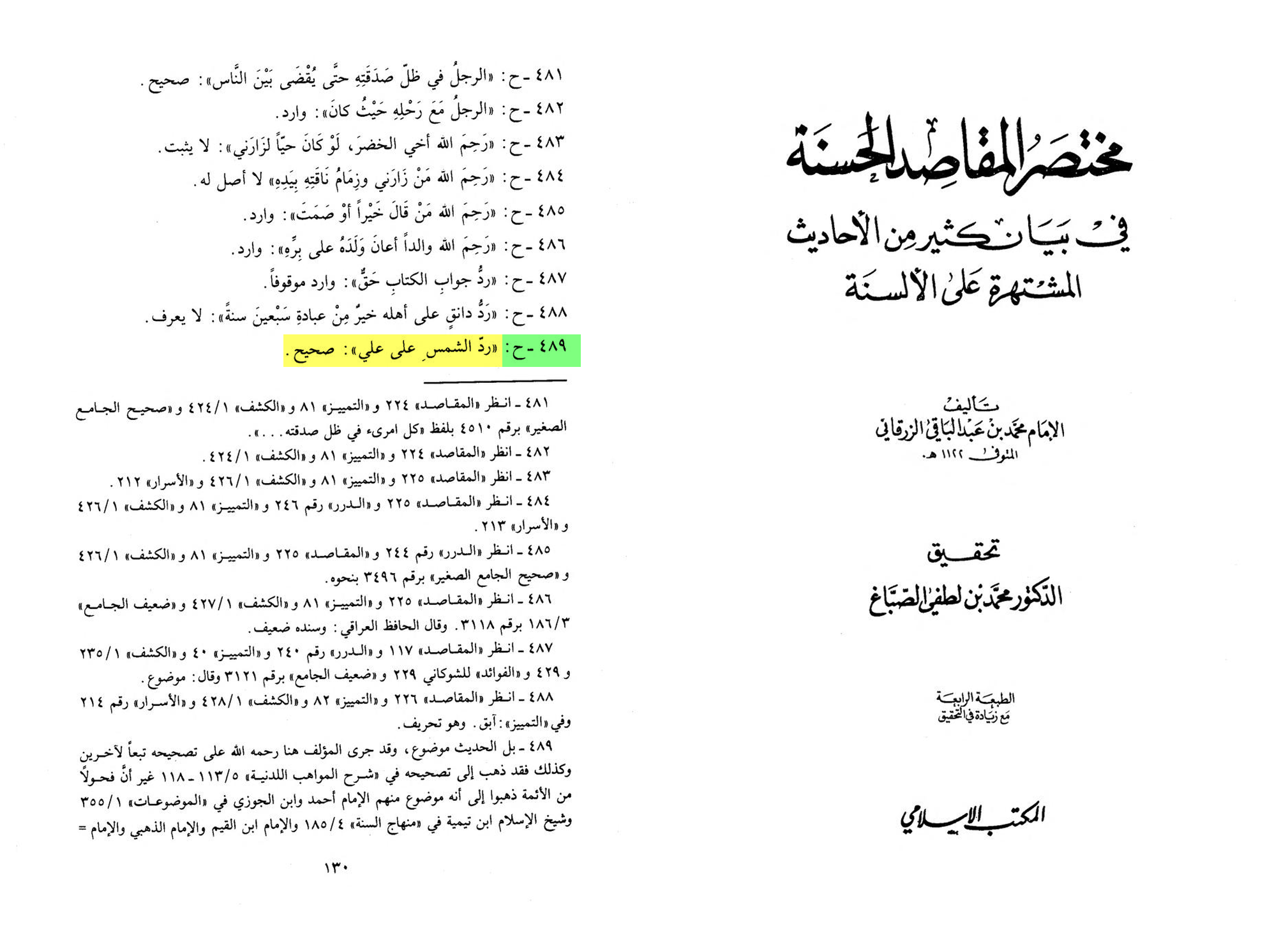
A renowned Sunni Maliki jurist Muhammad al-Zurqānī in his book al-Maqasid al-Hasanah, page 130 says:
“The return of the sun for ʿAlī”: authentic (ṣaḥīḥ).
Uploaded on: 2026-01-17 07:42:28
Credit: alkarbala_scans

A leading sunni maliki Jurist Qāḍī ʿIyāḍ ibn Mūsā al-Yaḥṣubī (Abū al-Faḍl) in his book al-Shifāʾ bi-Taʿrīf Ḥuqūq al-Muṣṭafā, page 347-348 states:
Al-Ṭaḥāwī has reported it in Mushkil al-Ḥadīth, from Asmāʾ bint ʿUmays, through two chains of transmission, that the Prophet ﷺ was receiving revelation while his head was resting in ʿAlī’s lap. Because of this, ʿAlī did not pray the ʿAṣr prayer until the sun had set.
The Messenger of God ﷺ said: “Have you prayed, O ʿAlī?”
He replied: “No.”
The Messenger of God ﷺ then said: “O Allah, he was engaged in obedience to You and obedience to Your Messenger, so return the sun for him.”
Asmāʾ said: “I saw it set, then I saw it rise again after it had set, and it stopped upon the mountains and the land. This occurred at al-Ṣahbāʾ in Khaybar.”
Uploaded on: 2026-01-17 07:28:53
Credit: alkarbala_scans